The STM Solivar Museum in Prešov is one of the most attractive technical monuments and is unique of its kind within the broader European cultural landscape.
The complex of the STM Solivar Museum in Prešov is a national cultural monument. It ranks among the most significant technical monuments in Slovakia, comprising a unique complex of technical and technological structures for pumping and boiling salt that dates back to the 17th century.
Among the most interesting structures is the *Gápeľ*—an ingenious mechanism for pumping brine using horse-drawn power. The complex also includes the *Četerne* (brine reservoirs), the František Boiling House, the Salt Warehouse, and the *Klopačka* (signal tower).
 Salt was discovered, mined, and boiled within the territory of what was later the village of Soľná Baňa; this village subsequently became part of Solivar, an entity formed by the merger of three villages (Soľná Baňa, Šváby, and Solivar). In 1971, Solivar became a borough of Prešov. The village of Solivar took its name from the salt springs located at the foot of the Slanské Hills. The utilization of brine (a water solution saturated with salt) in this area dates back to the 11th century and is linked to several noble families—most notably, from the 13th century onwards, the Soós de Soóvar family. Between 1572 and 1752, under the Habsburgs, rock salt was extracted here via deep mining alongside the production of brine.
 Exploration and development of the deposit were carried out using shafts—which served multiple functions—due to the geological conditions of the deposit. Several shafts were sunk into the deposit. The names of some have been preserved: Leopold (originally the Imperial Shaft, 155 m deep), Vetracia (Ventilation Shaft, 81 m deep), Mária (80 m deep), Jozef (151 m deep), and Ján Nepomucký (85 m deep). The most famous shaft, Leopold, was vertically divided into three main levels: upper (-80 m), middle (-133 m), and lower (-151 m).
A major turning point in the saltworks' history occurred in 1752; on the night of February 20–21, a massive influx of water surged into the mine galleries of the Leopold shaft, eventually flooding the lower and middle levels. In the early 19th century, two new salt-boiling plants—František (1800) and Ferdinand (1806)—were constructed; a major overhaul of the horse-driven hoist mechanism was undertaken, and new brine reservoirs, a salt warehouse, and a navigable canal were subsequently built.
A miners' church dedicated to St. ... was also built within the saltworks complex. ...of John the Baptist (the first one stood between the *Gápeľ* building and the Chapel of St. Roch, but was demolished due to structural instability). In the 1830s, the complex was expanded to include the Chapel of St. Roch (1832), built to ward off the plague epidemic that had swept through the village in 1831. Additional operational and administrative buildings were also added, creating a comprehensive historical-technical complex centered on the original saltworks.
The *GÁPEĽ* is a unique structure and hoisting mechanism located above the Leopold Shaft; it is considered a structure of European significance. It was originally built in the 18th century.
Wooden reservoirs—tanks used to store brine pumped from the shaft—were housed in a building known as *ČETERNE* (1815).
The *FRANTIŠEK* Salt Boiling House was built in 1800, with construction carried out by saltworks experts from Austria. This two-story Baroque-Classical building, featuring side wings, underwent numerous renovations and changes to its technical equipment—often necessitated by frequent fires. The last major fire occurred in 1819. The boiling house remained in continuous operation until 1970. The renovation of the František Boiling House was completed in 1997, and in May 2001, a new permanent exhibition by the Slovak Technical Museum—themed "The History of Salt Mining and Production in Solivar"—was opened to the public.
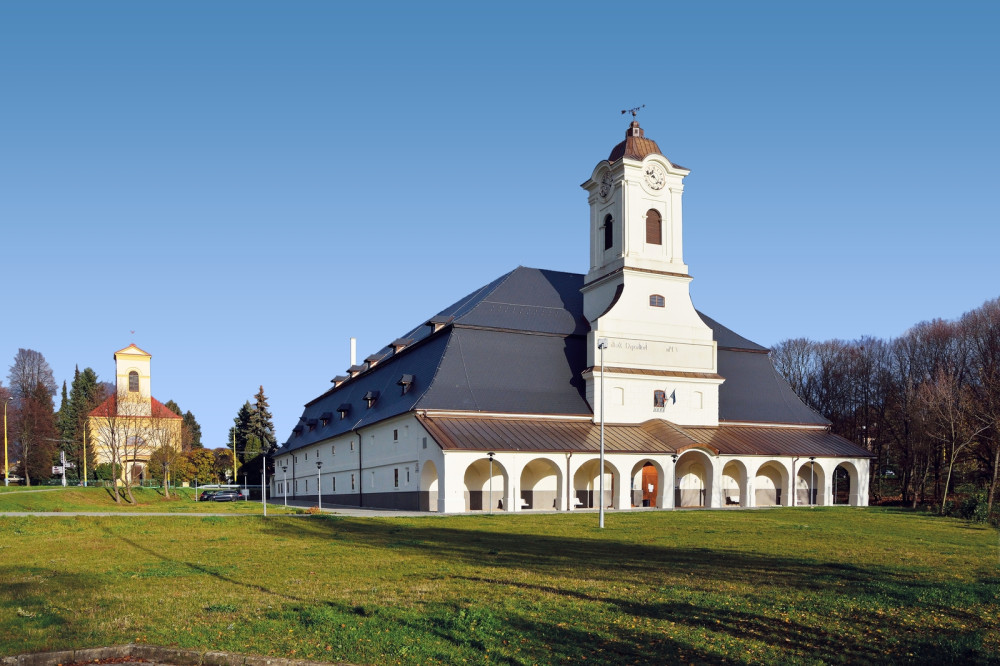
Salt was stored in individual chambers within the Salt Warehouse; architecturally, this is the most impressive (Late Baroque) building in the complex and serves as the landmark of the historic saltworks. It acquired its final appearance following the 1819 fire, when a second story and a tower were added, a tower clock was installed, and the roof was reconstructed. The building burned down again on May 18, 1986—destroying the rare pegged roof truss structure—and subsequently fell into disrepair. The historic Salt Warehouse has since been renovated to include a modern congress hall and spaces for museum activities as well as cultural and social events.
The Mining Signal Tower (or *Klopačka*) stands on elevated ground; it originally served a signaling function, announcing the start of work shifts. Although the old Solivar plant no longer produces salt, its former glory is being revived in a new form through the unique museum, which honors the *genius loci* of the historic Salt Mine. The original site of the former pan-evaporation saltworks also included other structures: the Salt Baths—popular among the Hungarian nobility and the urban middle class—the Engine House, the Carriage House (Stables), the blacksmith workshops, the *Mindžala* building, and others. Wood for the furnaces was transported via a unique water channel, which was later replaced by a narrow-gauge railway with its own depot.
As a unique complex of technical, technological, and historical structures, the site of the historic pan-evaporation saltworks embodies qualities of uniqueness, monumentality, and the ingenuity of its creators, serving as a significant witness to our history. The site is managed by the Slovak Technical Museum in Košice.