Branches
Since its inception, aviation has driven development across various fields of global technological progress. Because the weight and dimensions of aircraft were critical factors, the aviation industry played a pivotal role in advancing technologies such as metallurgy, mechanics, aerodynamics, thermodynamics, electrical engineering, electronics, and radio engineering.
 Practical aviation began to develop in the early 20th century. The exhibition features over twenty rare historical aircraft engines dating from 1915 to 1945. The collection includes piston, inline, and radial engines—both air- and liquid-cooled—manufactured between the pre-World War I era and the end of World War II in Russia (the Soviet Union), Austria-Hungary, Great Britain, France, Germany, and Czechoslovakia. Models and replicas of aircraft such as the Blériot XI, Deperdussin, Demoiselle, Spad-7, BH-11, and B-534, alongside a restored Me 109 G14/AS, illustrate the evolution of airframe design as well as advancements in aerodynamics and flight mechanics. This exhibition, showcasing original piston engines and replicas of pioneering aircraft from the first half of the 20th century, is located in the museum's first hall.
 One of the early engines was the water-cooled, inline Austro-Daimler (producing 162 hp; dating from 1916 and used in the Aviatik D.1 and Lohner C.1 aircraft). Equally rare is the French water-cooled radial engine, the Salmson Canton-Unné (150 hp, produced under license in Russia in 1916). Early aircraft utilized modified water-cooled inline automobile engines; for instance, the renowned automotive designer Porsche worked with the Austro-Daimler engine. The Blériot XI aircraft was designed by the French engineer Louis Blériot; after several attempts, it successfully crossed the English Channel for the first time. Suspended above the Blériot is the Demoiselle—powered by a 25.7 kW Dutheil-Chalmers engine—which was designed by the prominent Brazilian aviation pioneer Alberto Santos-Dumont; the aircraft's bamboo tail structure was a particularly interesting feature. Another notable aircraft from this era is the Deperdussin, famous for its appearances at various airshows. In 1910, it broke records and outperformed rival machines from legendary manufacturers such as Wright, Curtiss, Farman, Voisin, and Blériot. Another exhibit is the Walter Scolar, a nine-cylinder, air-cooled engine delivering 160 hp at 2,200 rpm. Developed at the Walter Prague plant in 1936, it is one of the few surviving examples of this engine. This richly illustrated chronicle of aviation history continues with the first crewed flight. In Annonay, France, the Montgolfier brothers built the first spherical, hot-air balloon. The first crewed flight took place on November 21, 1783. The era of lighter-than-air craft came to an end with the disaster of the LZ 129 *Hindenburg*—a German airship destroyed by fire on May 6, 1937, while landing at Lakehurst Airfield in New Jersey, USA.
Among the early aviation pioneers in Slovakia were Ján Bahýľ, inventor of a gasoline-powered helicopter (1905), and Štefan Banič, inventor of the parachute. Banič’s parachute was patented in the USA in 1913. He demonstrated his invention to US Army officials by jumping from the 15th floor of a building—a feat he survived. Modified versions of this parachute design remain in use to this day.
The piston engine exhibit continues with the Praga B engine. This is an air-cooled, flat-twin engine with a standard output of 36 hp at 2,400 rpm and a maximum output of 40 hp at 2,500 rpm. It ranks among the most powerful and lightweight engines of its type. The Zlín Persy II is an engine of similar design. The four-cylinder, air-cooled engine was developed by the Baťa company in 1936. It produced 45 horsepower and was used in the Zlín Z-XII aircraft. A total of 270 units were manufactured. The Persy engine featured a modern design for its time; it lacked a reduction gear, meaning the propeller was connected directly to the engine's crankshaft.
A more powerful—though significantly heavier—engine is the M-11D, designed by the Russian engineer A. D. Shvetsov. This five-cylinder, air-cooled radial engine (with cylinders arranged in a star pattern) was produced in the Soviet Union starting in 1928.
In the early days of aviation, one of the most significant figures in our history—General of the French Army, scientist, aviator, and politician Milan Rastislav Štefánik—was also a successful pilot. He began flying in 1915 and was awarded the French *Croix de Guerre* for his aviation activities. The end of his life was also closely linked to flying; in 1919, while returning to Czechoslovakia as the Minister of War, he crashed during the landing at the Ivánka airfield near Bratislava. The Italian-designed Caproni Ca.33 aircraft crashed upon descent, resulting in the deaths of M. R. Štefánik and the three-person crew.
The exhibits also include a collection of propellers at various stages of production, ranging from the initial phase to the finished product. These are propellers that largely originate from German aircraft of the World War II era, ranging from the earliest fixed wooden ones to metal ones.
At the rear of the hangar, one finds the combustion chamber and exhaust nozzle—the main components of the A-4 liquid-propellant rocket engine used in the German V-2 rocket, which generated 270 kN (27 tonnes) of thrust. The engine, including its auxiliary units, weighs 980 kg. This rocket engine powered the German V-2 missile. Its development was completed by the German-American rocket scientist and engineer Wernher von Braun and his team at Peenemünde around the turn of 1938 and 1939.
The ZOD-260 radial engine, manufactured starting in 1933, featured an interesting design. It is an air-cooled, two-stroke diesel engine. Engine intake occurs via ports covered by the piston, while exhaust gases are expelled through a pair of valves located in the cylinder head. The fuel injection system was designed by Bosch. The engine's maximum power output is 300 hp at 1,650 rpm; it had a displacement of 13.25 liters and weighed 299 kg.
 The Junkers Jumo 205 is an interesting six-cylinder, liquid-cooled inline engine featuring vertically opposed pistons. It was the first engine to employ two pistons within a single cylinder operating in opposition to one another. It is a two-stroke diesel engine and was the first—and most successful—aviation diesel engine of the mid-20th century. It featured six cylinders and twelve pistons (with two pistons per cylinder). The pistons were connected via connecting rods to two crankshafts, which were linked by a gear train.
The BMW 132—a radial engine—was manufactured in Germany starting in 1933 under license from Pratt & Whitney (based on the Hornet design). Initially producing 725 hp, the engine was progressively improved to reach an output of 850 hp. It was an air-cooled, nine-cylinder spark-ignition engine. It was primarily used in the famous Ju 52/3m transport aircraft; 4,845 of these aircraft were produced in Germany alone. One of the largest exhibits in the hangar is a model of the Avia Bk-534 aircraft. This full-scale model bears the markings of the Czechoslovak Air Force and a flight unit stationed in Slovakia (Spišská Nová Ves). Designed by František Novotný, the aircraft was manufactured at the Avia factory and powered by a French Hispano-Suiza 12 Y crs engine.
The Avia B-534 gained significant popularity, particularly following the 1937 air competition in Zurich; it boasted superior maneuverability and a high rate of climb at low altitudes. The Avia B-534 holds a unique world record: the victory achieved by František Cyprich, who shot down a German Junkers Ju-52—marking the last aerial kill ever achieved by a biplane.
The engine exhibit continues with the French manufacturer Renault, which produced the Renault 6Q series (models 01 through 19) during World War II. Notable among these were the 08/09 Bengali engines—220 hp, six-cylinder, inverted, air-cooled units. They powered the Caudron C 445 Goéland, an aircraft used for multi-engine pilot training, courier duties, and air ambulance services. Between 1942 and 1943, the Slovak State purchased several of these aircraft, including for the transport of wounded soldiers from the Eastern Front. An exhibit closely linked to the interwar period is the Avia BH-11 aircraft. It is designed as a braced low-wing monoplane featuring fixed conventional landing gear with a tail skid. The airframe is constructed of wood, with some metal components (specifically the movable tail surfaces). The fuselage is covered in plywood and fabric. The aircraft was powered by a five-cylinder, air-cooled Walter NZ-60 radial engine.
 The Spad S.XIII aircraft is located in the central part of the exhibition. It dates back to the First World War. It is a fighter biplane designed by the French aircraft designer and aviation pioneer Louis Béchereau and manufactured by the French company SPAD. It was the successor to the highly successful SPAD S.VII. Large numbers of SPAD aircraft were used by Allied forces on the fronts of the First World War. The aircraft was faster than its adversaries (the Fokker D.VII and Sopwith Camel), though its maneuverability—particularly at low speeds—was poor.
The AM-38F is one of the final exhibits in this hall directly linked to the Second World War. These are aircraft engines from an era that saw a dramatic increase in engine performance; power outputs were no longer measured in the hundreds, but in the thousands of horsepower. A prime example of this is the Mikulin AM-38F engine, a classic representative of the Russian (Soviet) school of engineering design. During World War II, Chief Designer A. A. Mikulin designed several piston engines (AM-34, 35, 38, 42). All these engine types—water-cooled, V-12, carbureted, and supercharged—were based on a single design concept. The AM-38F had an output of 1,680 hp. The engine weighed 880 kg.
The final piston aero-engine in the exhibition is the Rolls-Royce Merlin. It is a liquid-cooled, 27-liter, V-12 piston engine (with a 60° cylinder angle) manufactured during World War II by the British company Rolls-Royce Ltd. and under license by the American automaker Packard as the V-1650. The Rolls-Royce Merlin is considered one of the finest piston aero-engine designs ever created.
The centerpiece and highlight of Hangar I is the display at its far end: a diorama featuring a restored Messerschmitt Me 109 G-14/AS and the cockpit of an Me 110, largely fitted with original instruments. This exhibit—the Me 109 G-14/AS—was assembled using mostly original parts; it possesses a unique history and is a rarity among European aviation museums.
 The date is December 31, 1944. There were no New Year's Eve celebrations at Luftwaffe airfields on the Western Front. In the early hours of January 1, 1945, Operation Bodenplatte—an attack on enemy airfields—was launched. JG 53 and its 13th Squadron participated in the assault. One of the participants was *Unteroffizier*... (Non-commissioned officer) Herbert Maxis flew a Messerschmitt Bf 109 G-14/AS (serial number 784993), marked as "White 13." He was shot down by anti-aircraft artillery near Metz-Frescaty, France, and made a forced landing close to anti-aircraft positions. Upon exiting the aircraft, he was shot and killed for unknown reasons. The wreckage remained at the site for several months, gradually being stripped of parts. Eventually, a local farmer pushed the remains into a pit and buried them. It was not until 1988 that Mr. Raymond Wagner, a nearby resident, excavated and subsequently restored the aircraft. He installed many replacement components in the stripped airframe—particularly in the cockpit area—such as the wing spar bridge, landing gear assemblies, and the firewall. Mr. Wagner completed the restoration project in 2004, after which the aircraft passed to the Messerschmitt Foundation (EADS), an organization known, among other things, for operating the only three airworthy Me 109s in Europe. Mr. Jürgen Dilger subsequently acquired the aircraft from the Foundation. Over time, it became apparent that the aircraft could not be restored to airworthy condition. Mr. Dilger visited the STM-ML (Aviation Museum) and discovered a DB-605 aero-engine among the exhibits that could potentially be overhauled to flight-ready status. He therefore proposed an exchange to the Aviation Museum: the DB-605 engine in return for the partially restored Bf 109 G-14/AS. ...serial number 784993, featuring a DB-605/AS engine and an original Messerschmitt 109 wing. Following approval by the Ministry of Culture of the Slovak Republic, the exchange was carried out at the STM-ML with the personal participation of Mr. Dilger, who personally accompanied the Bf 109 G14/AS on its journey to the Aviation Museum in Košice. Subsequently, a plan for further restoration was developed and successfully implemented between 2014 and the end of 2016.
Since May 2017, the Messerschmitt Bf 109 G14/AS (s/n 784993) has been part of the STM-ML exhibition titled "The Beginnings of Aviation up to 1945." This exhibit marks the conclusion of the era of aircraft development spanning from the early days to 1945 (Hall 1) and introduces the documentation of aviation's subsequent evolution—which continues to the present day in various forms and is showcased in other sections of the Aviation Museum.
The Aviation Museum’s exhibition documents the evolution of aviation from the late 1940s to the present day. The display is concentrated primarily in Hall No. 2. Engines produced by the Walter company are typical representatives of the piston engines from this era. The company was founded in 1911 in Bohemia (then part of Austria-Hungary) by Josef Walter, a pioneer of Czech motoring; initially, it did not manufacture aircraft engines. The Walter Minor 4-III became a notable example of such an engine. Its development began in the 1930s. It is a simple, air-cooled, carbureted, inverted inline four-cylinder engine. It had a displacement of 4,000 cc and an output of 77 kW (105 hp) at 2,550 rpm. The Aero 45 is one of the successful aircraft to utilize this engine; aircraft equipped with these engines set several records. In 1949, the Ae-45 (registration OK-DCL) won the Norton Griffiths race in Great Britain. The Praga D engine also saw use in the post-war period. It is designed as an air-cooled, four-cylinder flat engine (boxer configuration) with an output of 75 hp. The Praga D and DH engines were also used in the early HC-2 helicopters, though they were eventually replaced by more powerful engines due to their low output (86 hp). The use of jet engines became widespread, particularly in the Soviet Union, where British Rolls-Royce engines were manufactured under the designations RD-500 and RD-45 (the latter subsequently modernized into the VK-1).
 The RD-45 was developed based on the design of the British Rolls-Royce Nene I and Nene II engines (designated RD-45 and RD-45F, respectively). It is a turbojet engine featuring a double-sided, single-stage centrifugal compressor, nine tubular combustion chambers, a single-stage gas turbine, and a fixed propulsion nozzle. The RD-45, RD-45F, and VK-1 engines powered the standard fighter aircraft of the era, the MiG-15 and MiG-15bis.
 The post-World War II period marked the beginning of the helicopter era. Czechoslovakia also initiated the development of this type of aircraft after the war. Notable examples included the HC-2 and HC-102 helicopters (the HC-102 featured the more powerful M-110 H engine). Development of the HC-102 began in 1951 within the prototype department of the Aero company; later, development continued at VZLÚ Prague. The prototype helicopter made its maiden flight on December 3, 1954; it was the first Czechoslovak helicopter to enter serial production. The chief designer was Ing. Jaroslav Šlechta. Pilot Rudolf Duchoň set an international speed record on a closed 100-kilometer circuit, achieving a speed of 120 km/h. in subclass E-1 (up to a weight of 500 kg).
The post-war period also saw a boom in unpowered flight (gliding). One representative of this category of aircraft is the Z-25 (125, 425) Šohaj. The first Šohaj Z-25 underwent flight testing in 1947, followed by a production run of one hundred units. A total of 276 units of the modernized Z-125 were produced. Several aircraft of this type remain airworthy today. Aviation technology evolved in tandem with the development of jet engines.
One of the first Soviet turbojet engines featuring an axial-flow compressor was the RD-9. The development of the RD-9B engine was carried out by the design bureau of A. A. Mikulin and S. K. Tumansky. It is a single-spool, single-shaft engine featuring a nine-stage axial-flow compressor, a mixed-flow main combustion chamber, a two-stage partially cooled reaction-type gas turbine, and an exhaust system comprising an afterburner chamber, an extension pipe, and a variable-area exhaust nozzle. The engine powered the MiG-19, the first supersonic aircraft to enter mass production.
 Another promising modern-design turbojet engine—used in the Yak-40 aircraft and, in a modified form, in the L-39 military aircraft—is the engine created by Soviet designer A. I. Ivchenko. In the 1960s, a need arose to replace piston-engined aircraft. Ivchenko developed a new turbofan engine for the new tri-jet Yak-40 aircraft. A distinctive feature of the engine was the extensive use of titanium in its construction. A total of 6,300 AI-25 engines were produced. The engine served as the basis for a range of aircraft (Yak-40, L-39, K-8). Modifications were required for military applications, resulting in the AI-25 version and, subsequently, the modified AI-25TL. The engine was developed at the Motor Sich plant in Zaporizhzhia, Ukraine. The AI-25TL powers the L-39 Albatros aircraft. In total, approximately 3,000 L-39 Albatros aircraft across all versions (C, V, ZO, ZA, CM) were manufactured. Given the L-39's status as an undisputed success for the Czechoslovak aviation industry, development continued with the L-39MS (L-59) as its successor, followed by the currently planned L-39NG.
In the late 1950s, the then-Czechoslovak Republic was tasked with organizing the development and production of an agricultural aircraft. The XZ-37—a joint project between the Czechoslovak aviation companies Moravan Otrokovice and LET Kunovice—was selected during a design competition held in 1960. The prototype took off in June 1963.
The Z-37 is a cantilever low-wing aircraft featuring an all-metal wing and a fuselage constructed of welded steel tubing covered with synthetic fabric. The aircraft has fixed tailwheel-type landing gear. A low-wing configuration was chosen to ensure an unobstructed view during turns.
...and during steep banking. Its unusually high landing gear ensured the safety of the aircraft and propeller during landing and movement over uneven terrain. By the time production ceased in 1977, 650 aircraft had been built. Production resumed in 1983 and 1984, resulting in another forty units. The largest operators of the Z-37 were Agrolet and Slovair.
The aim was to utilize modern technologies for tactical-level reconnaissance. One of the first successful first-generation unmanned aerial vehicles (UAVs) was the Tu-143, designed by the Tupolev Design Bureau (OKB). While not the first operational vehicle of its kind, it was the first designed for repeated use. The "Rejs" system was developed starting in the mid-1960s, with the Tu-143 UAV playing the central role. It was developed in several versions, including a photographic variant, a television system variant, and one equipped with sensors for monitoring radiation levels. The Tu-143 Rejs system has since been replaced by more modern systems.
Among the greatest achievements of the Czechoslovak aviation industry during the 1950s and 1960s were the L-200 Morava aircraft and the Blaník glider.
L-200 Morava
Developing a new air taxi was the first task undertaken by the design team that began work at LET Kunovice under the leadership of Ing. ...by Ladislav Smrček starting in 1955. The result was a twin-engine, five-seat, all-metal low-wing aircraft featuring tricycle landing gear and twin vertical tail surfaces. The five-person cabin was designed similarly to that of a passenger car, even including ashtrays for smokers. The XL-200 prototype, powered by two six-cylinder Walter Minor 6-III engines, made its first flight on April 9, 1957. A more powerful M-377 engine became available in 1959. A total of 367 aircraft were produced; some were modified into air ambulances to transport patients on stretchers accompanied by medical personnel. They are still flying today in Africa, Australia, the Americas, and Europe.
 L-13 Blaník
Development of the L-13 Blaník glider began in 1954 at the design office of the Aeronautical Research and Test Institute (VZLÚ) in Prague-Letňany, under the leadership of chief designer Ing. Karel Dlouhý.
Production of the L-13 ended in 1978, with a total of 2,616 units manufactured. The Blaník glider has been used for pilot training since the 1950s. Blaníks remain in service today, including within the systems of numerous air forces around the world (such as those of Chile, Argentina, Canada, and Great Britain). According to witnesses, flight schools in the USA used a waiting list for flights, with delays of up to two weeks. The US Air Force even incorporated the Blaník into one of its bases for the basic training of military pilots. By the time production ended in 1978, 2,616 units had been manufactured, the majority of which are flown in more than forty countries worldwide.
Its name derives from gifts presented by individual nations across Europe, North America, and Asia. The exhibits consist primarily of military aircraft. The first official gift was a Su-15 aircraft presented by the President of Ukraine, Leonid Kuchma. The Aviation Museum also holds another gift from him: a launcher unit equipped with a dummy warhead for the SS-24 Scalpel intercontinental ballistic missile. In 2003, the government of the Republic of Poland donated a TS-11 Iskra—an aircraft designed and manufactured in Poland and the first jet aircraft developed there.
 The first of three aircraft to arrive via flight and land at Košice Airport was the Mirage III RS. Gifted by the government of the Swiss Confederation, it stands as one of the most elegant exhibits in the Presidential Gallery. The French Republic—specifically the *Direction Centrale du Matériel de l'Armée de l'Air*—donated a Mirage IIIE fighter jet to the museum at the initiative of French President Jacques Chirac.
The gallery acquired a Lockheed F-104 Starfighter from the Italian Republic as a gift from Italian President Azeglio Ciampi. It was transported to Košice by a massive C-130 Hercules cargo plane from the Rimini airbase, and Italian military specialists assembled the "Starfighter" in an incredible 20 hours on August 8, 2003.
A Northrop NF-5FA light fighter was donated in 2004 by the President of the Hellenic Republic, H.E. Konstantinos Stephanopoulos. One of the world's most widely used and best-known aircraft characterizing the Cold War era is the Phantom F-4F multi-role combat aircraft; it was a gift from the President of the Federal Republic of Germany and flew to Košice in 2004 after receiving approval from the US government.
 Northern Europe and the distinctive Swedish school of aviation design are represented by a gift from the Kingdom of Sweden: the supersonic multi-role Saab J 37 Viggen. Also from the manufacturer SAAB is a gift from the government of the Republic of Austria—the J-35 Draken, a second-generation interceptor fighter. It is a mid-wing aircraft featuring a double-delta wing configuration.
A unique exhibit at the Aviation Museum—and the only aircraft of its kind in Europe—is the Nanchang Q-5 fighter-bomber (NATO reporting name "Fantan"), an export version of the A-5/Q-5, gifted by the government of the People's Republic of China. Another rare and distinctive exhibit is the Soko J-22 Orao; it is one of the few combat aircraft developed outside the major manufacturing powers (specifically, in Yugoslavia and Romania). It is a single-seat, twin-engine, subsonic combat and tactical reconnaissance aircraft. It was donated in 2007 by the government of Romania. The Republic of Hungary is represented in the Presidential Gallery by a gifted Su-22M3 aircraft. It is the only aircraft in the Presidential Gallery that exemplifies the classic Soviet school of aircraft design. The helicopter category is represented by a gift from the Kingdom of Belgium: the Alouette II. This light helicopter was developed and manufactured by the French aerospace company Sud Aviation for a variety of roles—including reconnaissance, training, and rescue (both land and sea)—as well as combat operations, with the capability to deploy anti-tank missiles and anti-ship torpedoes.
 Another helicopter in a similar class is the UH-1 Iroquois (Huey). It was delivered to Slovakia in 2005 as a gift from the Indiana National Guard, arriving on a support transport aircraft accompanying President Bush during the Bush-Putin summit in Bratislava. It stands as one of the most successful helicopters in history and was the first turbine-powered helicopter used by the US military.
The presidential gallery also features aircraft powered by conventional piston engines. The smaller of these, the PO-2, is a gift from the Russian Federation. The Polikarpov PO-2 (U-2)—nicknamed "Kukuruznik"—is maintained in airworthy condition. First produced in 1928, it ranks as the second most widely produced aircraft in history; it is a biplane noted for its excellent flight characteristics. In 2005, the Russian Federation presented a replica of the Polikarpov Po-2 to former Slovak President Rudolf Schuster as a gift from President Vladimir Putin, marking the 60th anniversary of the Slovak National Uprising (SNP). The second aircraft in the presidential gallery sharing this same design philosophy is the An-2, a gift from Ukraine. In 1947, it was originally developed as an agricultural aircraft.
An exterior panel exhibition "Aviation Meteorology" offers a professionally prepared and understandable view of important topics of this scientific discipline.
 The introduction is dedicated to Milan Rastislav Štefánik, who, in addition to his military and political activities, also made a name for himself as an astronomer and meteorologist. His atmospheric research and measurements significantly contributed to the development of modern aviation meteorology. The next part of the exhibition presents the development of aviation meteorology in the Czech Republic and Slovakia - from the first organized measurements at the beginning of the 20th century, through the building of a network of meteorological stations, to today's professional meteorological service.
The panels dedicated to general meteorology explain the basic principles of the functioning of the atmosphere, which form the basis for specialized aviation meteorology. The visitor will become familiar with the measurement of temperature, pressure, humidity, and the observation of clouds, the types and development of which are important indicators of the weather. The exhibition also focuses on atmospheric precipitation, snow showers and wind, which fundamentally affect flight operations. A separate section presents the importance of sunlight and visibility for visual navigation.
Special attention is paid to dangerous weather phenomena such as storms, turbulence and icing. Their occurrence, risks to flight operations and forecasting methods are explained. The final part of the exhibition presents the system of aviation meteorological information (e.g. METAR, SPECI, TAF). The visitor will learn what data it contains, how it is obtained using modern instruments and how it is distributed to pilots and air traffic control.
 The exhibition also includes an original Stevenson weather booth, which contains basic instruments for measuring temperature and humidity. Visitors can see what this classic booth looks like, why it is placed on legs and how it protects the instruments from weather influences so that the measurement results are as accurate as possible. The exhibition thus offers a comprehensive and at the same time illustrative view of the history, principles and practical importance of aviation meteorology for the safety of both civil and military aviation.
Aircraft Structures
Aircraft structures have their own specific characteristics and unique features. In the early days of aviation, wood and fabric were the only materials used for construction. These basic materials sufficed at the beginning, when aircraft speeds hovered around 100 km/h. In the entrance area of the exhibition, two panels and a cutaway section of a wooden glider wing offer insight into the origins of aircraft structural design.
By the end of World War I, as aircraft speeds surpassed 200 to 300 km/h, materials like wood and fabric were no longer adequate. Designers had to seek out new materials. The material needed to combine high strength with low weight. Aluminum (Al) and its alloys (such as duralumin and Elektron) proved to be the most suitable choice. Aluminum was discovered in 1827 by the prominent German chemist and physician Friedrich Wöhler. By the end of the 20th century, aluminum and its alloys accounted for more than 80 percent of aircraft structural composition. Today, the manufacture of modern aircraft—particularly commercial airliners—increasingly relies on composite-based materials, such as carbon fiber. Visitors have the opportunity to examine the standard aeronautical design features of the following aircraft and helicopters:
L-200 Morava
The design of light transport aircraft is illustrated in the exhibition by the L-200 Morava, which also showcases the achievements of the Czechoslovak school of aviation engineering. Produced in the 1950s, the aircraft is characterized by its twin vertical stabilizers, which enhance longitudinal stability. For many years, the L-200A model was used to train students from the Department of Air Transport at the University of Žilina.
Mi-2
By removing sections of the airframe panels, visitors can view the structural layout of individual components and systems, the placement of powerplants, and the construction of the helicopter's main and tail rotors. This structural configuration is currently used in over ninety percent of helicopter designs (exceptions include helicopters designed by Kamov—such as the Ka series—and heavier helicopters like the CH-47 Chinook). A partial diorama surrounding the Mi-2 also provides insight into the logistics of its operation.
 MiG-21
Visitors can observe classic modern aeronautical design features in the structure of the MiG-21 MF aircraft. In the exposed sections of the structure, individual airframe components are visible: beams, ribs, spar caps, uprights, the airframe's stressed-skin covering, and the placement of various onboard system components.
Essentially, the MiG-21 displays standard airframe and system construction elements that remain in use today. To expand the MiG-21's operational capabilities, external pods—designed for reconnaissance (photography), radio operations, and electronic warfare (EW)—are displayed nearby; such pods enhance the aircraft's combat value and are employed by air forces worldwide in various configurations.
Modern aircraft design increasingly utilizes new materials, such as composites, carbon-based materials, and sandwich structures.
This trend is illustrated by the all-composite WT 3 aircraft—designed by Slovak aviation engineer and pilot Tadeáš Wala (of Czech origin)—and by individual composite components from the Airbus aircraft family.
Aero Engines
 Combustion chambers represent a key component of jet engines. The main types of combustion chambers (and their primary sub-assemblies) are on display: a combined combustion chamber from the R-11F-300 engine (MiG-21), a tubular combustion chamber from the M-701 engine (L-29), and an annular combustion chamber from the Saphír-5 air generator (L-39). The design of the jet engines derived from the AL-21F-3 and R-27F-300 models is particularly interesting.
The exhibition also includes simulator components, which illustrate the layout of the cockpits in the Su-25 and L-29 military aircraft. Nowadays, given that a single hour of flight time in modern aircraft costs millions, flight simulators are used for a portion of pilot training. With current technology, flight conditions can be simulated with over ninety percent accuracy.
Aero Engines in the Latter Half of World War II
The first truly viable jet engines saw service during the latter part of World War II. Three jet engines are featured in the exhibition: the Jumo 004, the RD-45, and the DV-2.
Jumo 004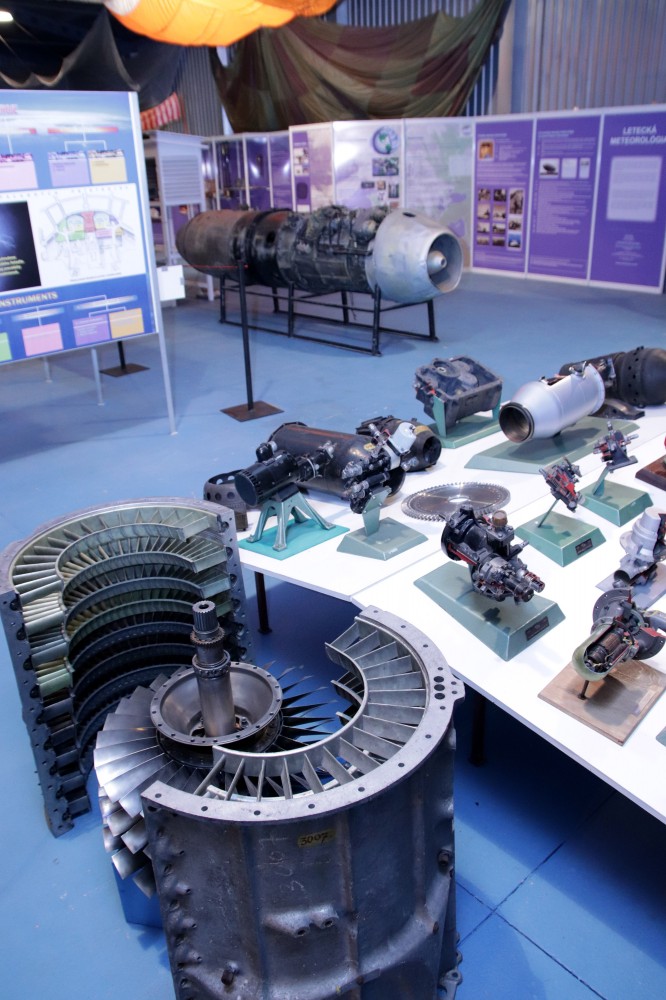 The Junkers Jumo 004 was one of the most widely used engines at the end of World War II. It was the world's first mass-produced jet engine. This exhibit marks the beginning of a new era in aero-engine design—and, in close conjunction, the design of new aircraft. It was the first successful jet engine to feature an axial-flow compressor. During the war, the German company Junkers manufactured 8,000 Jumo 004 engines, which powered the Me-262 fighter and the Arado Ar-234 bomber. Technical specifications: engine length 3,860 mm, engine diameter 810 mm, engine weight 719 kg. The engine features an eight-stage axial compressor, six tubular combustion chambers, and a single-stage axial turbine. Engine thrust was 8.8 kN at 8,700 rpm; fuel consumption was 1,220 l/h.
Later, in Great Britain, Rolls-Royce developed the Nene, a turbojet engine featuring a double-sided single-stage centrifugal compressor, nine tubular combustion chambers, a single-stage gas turbine, and a fixed propelling nozzle. This engine was installed in later versions of the Gloster Meteor aircraft. British Prime Minister Clement Attlee gifted forty of these engines to the Soviet Union in recognition of its contribution to the defeat of Nazi Germany. The RD-45 engine, designed by Viktor Klimov, was a copy of this design. The RD-45 became the powerplant for the MiG-15, the standard fighter of that era. The engine's maximum takeoff thrust was gradually increased to 2,700 kp (26.48 kN) at 11,560 rpm. The final version, designated VK-1F and equipped with an afterburner, delivered a short-term thrust of 3,380 kp (33.15 kN).
DV-2
The final engine is the DV-2 (where D stands for Dnieper and V for Váh). Its design was carried out by the V. A. Lotarev design bureau at the Progress scientific and research association (located at the Motor Sich facility), while subsequent development and production were handled by Považské strojárne in Považská Bystrica. The DV-2 is a twin-spool turbofan engine featuring a supersonic single-stage fan. The DV-2 turbofan engine features an advanced technical design intended to meet customer requirements for the next thirty years; production was envisaged to continue up to the year 2020. Engine development in Považská Bystrica was led by engineer Jiří Bednář. The DV-2 turbofan engine powers the L-39MS, L-59, L-59E, and L-59T jet trainers. A modified variant, the DV-2S, is used in the prototype of the twin-engine Yak-130 combat trainer. A total of sixty engines were manufactured. The engine's maximum takeoff thrust is 2,450 kp (24.50 kN), and its weight is 439 kg. The engine was modern in its design concept, featuring an acceleration time of 4–6 seconds to maximum RPM.
The accompanying display panels for the individual engines clearly illustrate the evolution of jet engine design over the past fifty years.
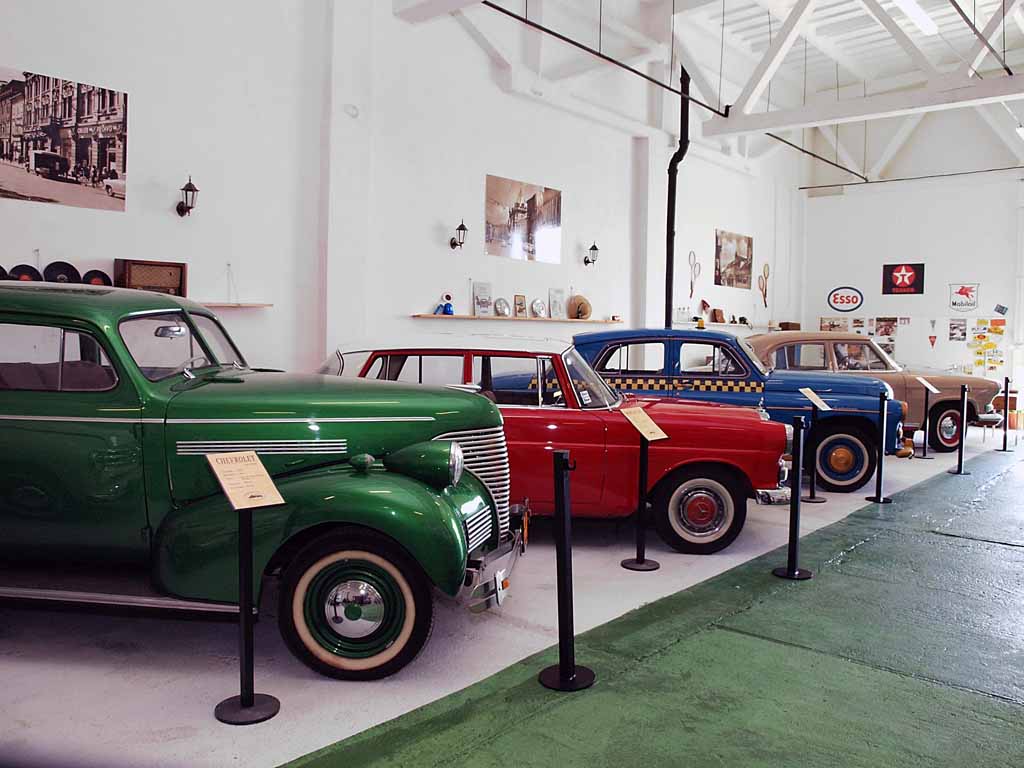 For over a century, the automobile phenomenon has permeated every sphere of life, shaping the technical and aesthetic sensibilities of generations. The Slovak Technical Museum, in collaboration with the CASSOVIA RETRO Košice Veteran Club, opened a permanent Road Transport exhibition on the grounds of the Aviation Museum (Part I opened on May 1, 2008). Thanks to the combined efforts of Košice’s vintage vehicle enthusiasts and the willingness of owners to loan their cars and motorcycles, years of work culminated in a permanent exhibition hall dedicated to a collection of rare, restored vintage vehicles.
The exhibition showcases road transport through a collection of motorized and non-motorized vehicles, ranging from historic bicycles and motorcycles to passenger cars and trucks. Visitors will find vehicles that are particularly representative of Czechoslovak manufacturing. Exhibits from the Slovak Technical Museum’s own collections further enhance the period atmosphere. Notable highlights include a Tatra 57 semi-convertible (1932), a Praga Piccolo (1934), a Jawa Minor Roadster, and an Opel Kapitän (1950)—the only roadworthy example in Slovakia. Other rarities include a 1939 Citroën and a 6-cylinder Chevrolet from 1940.
The motorcycle display features pre-war models such as the ČZ Jawa "Pérák," among many other exhibits. Two dioramas have been created for road transport history enthusiasts, evoking a nostalgic glimpse into a 1950s repair garage and workshop, complete with a classic workbench equipped with vintage tools used for vehicle construction and repair. The second diorama depicts a military setting during a combat exercise, featuring a period combat vehicle and numerous artifacts—such as historical uniforms—that reflect the 1960s.
A highlight for collectors is the rare collection of World War I and II helmets and gas masks. The road transport exhibition, housed across two halls, comprises a total of 30 vintage automobiles and 8 motorcycles, with the collection of period vehicles also including popular bicycles. As most of the exhibits are in running condition and participate in historic rallies and parades, the display is dynamic, with the specific vehicles on show changing over time. Plans are also in place to add workshop equipment to the site for the restoration of vintage vehicles. Thanks go to all the enthusiasts who contributed to the creation of this impressive collection by the Slovak Technical Museum.